Blog
January 14, 2026
2026: From Co-pilots to Colleagues – Hiring Your First Digital Employee

Tal Segalov
Co-Founder & CTO
For the last few years, we’ve been living in the era of the LLM.
For the last few years, we’ve been living in the era of the LLM. 2024 and 2025 were the years of the Co-pilot—those handy, glorified autocomplete tools that sit in your IDE or your email, waiting for a prompt. They were a massive productivity hack for individuals, but let’s be honest: they were still just tools. They waited for you to tell them what to do.
As we enter 2026, the vibe is shifting. We are crossing the Agentic Event Horizon. We aren’t just adding more “manpower” to projects (a move Fred Brooks warned us against decades ago); we are hiring Digital Employees.
The difference is fundamental. A co-pilot assists you; a digital employee does the job
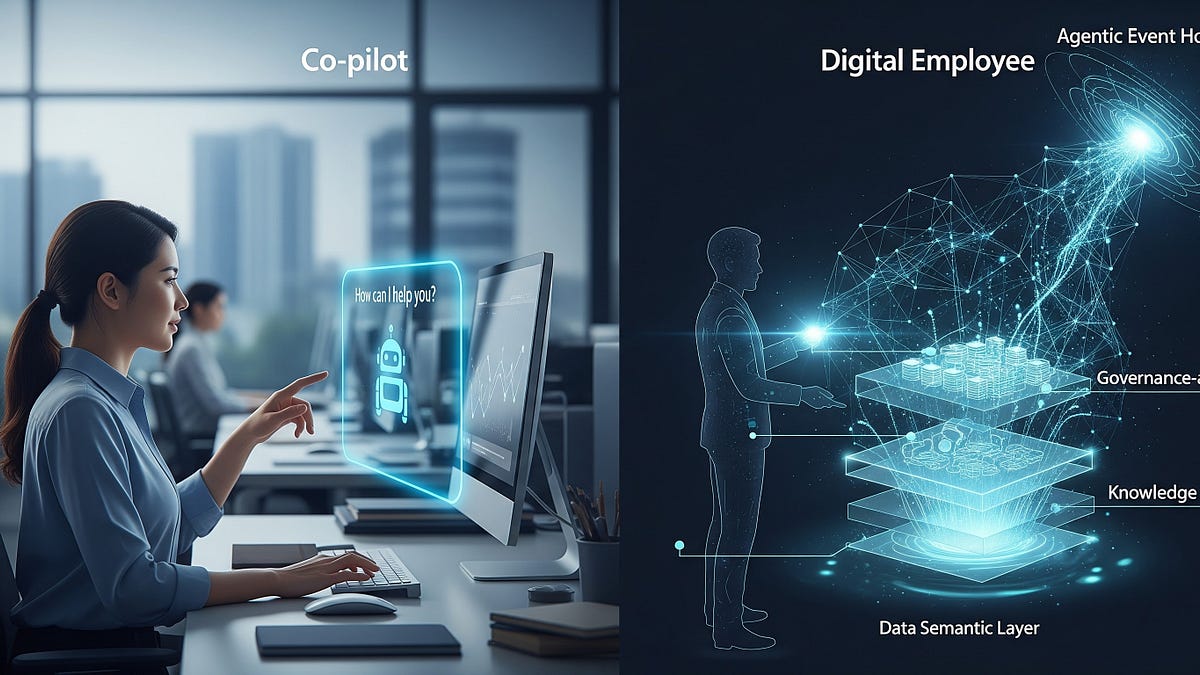
The Vibe Shift: Co-pilot vs. Digital Employee
In Solid’s recent hackathon, I saw this loophole in action. Usually, a hackathon is a caffeine-fueled marathon of manual keyboard-smashing. This time, I wrote fewer lines of code than ever. Instead, I wrote English. I acted as the Architect, while my “AI colleagues”, my digital employees, handled the construction.
A Co-pilot is reactive. It suggests a line of code or summarizes a meeting.
A Digital Employee is proactive. It takes a Jira ticket, analyzes the existing 400k lines of backend code, finds the required hooks, writes the PR, and ensures it passes the tests. It manages its own “to-do” list. It doesn’t just suggest the “how”; it executes the “what.”
The Infrastructure: You Can’t Navigate 2026 with a 1925 Map
You can’t just buy a digital employee off the shelf and expect them to start on Monday. To hire them in an enterprise, you need to build their Cognitive Architecture
As I’ve written before, an AI is only as smart as its map. If you hand an overconfident genius a map of the Bay Area from 1925, they’ll still give you directions—they’ll just be confidently wrong. To make a digital employee effective, you need:
- The Data Semantic Layer:This is the “Detailed Librarian.” It educates the AI on business logic so it doesn’t hallucinate “Revenue” based on a legacy table that hasn’t been used since the Clinton administration.
- Usage as the New Schema: Digital employees need to read your “Data’s Diary.” They need to understand not just the static schema, but how humans actually use the data—the “desire paths” found in query logs and dbt models.
- Built-in Governance: Governance shouldn’t be the brake; it should be the steering wheel. To let an agent operate autonomously, you need “Governance-as-Code” to ensure it stays within safe boundaries.
Onboarding and Training: Teaching the Tribal Knowledge
Onboarding a digital employee looks a lot like onboarding a human. You have to teach them the “local slang.”
We do this by feeding them the Interconnected Knowledge Graph of the company. They need access to your internal wikis, Slack channels, and historical PRs. This is where they learn the “Tribal Knowledge” that usually only lives in people’s heads. Training isn’t about fine-tuning a model on the internet; it’s about grounding it in your specific, granular context—your “Golden Paths.”
Maintenance, Auditing, and the “Knowledge Loss” Problem
When you “fire” or rotate a digital employee (e.g., upgrading to a new model or switching providers), the fear is knowledge loss. But here is the loophole: unlike humans, a digital employee’s knowledge is externalized.
By forcing them to document their work, the “why” behind the code and the “how” of the process, as a mandatory part of their “Definition of Done,” you actually gain institutional memory. At Solid, we’ve turned our developers and QA engineers into Bot Managers and Semantic Auditors. Their job isn’t to build; it’s to critique and verify. They ensure the machine’s output adheres to the “Ground Truth.”
We monitor them through aggressive automation and regression testing. If the AI writes the code, the human must ensure it works every time. The “Sprint” becomes a misnomer because we aren’t running - we’re flying.
The Bottom Line
The winners in 2026 won’t be the companies that buy the most AI licenses. They’ll be the ones that architect their infrastructure to let their digital employees “vibe” safely and productively.
We need to stop treating data documentation as a chore and start treating it as the core operating system for this new workforce. The industrial revolution for code is here. Are you still navigating with a 1925 map?
Other posts