Blog
October 5, 2026
Why Enterprise AI Projects Fail (And Why It Usually Isn’t the AI)

Allison Parlett
Marketing Associate
.png)
Enterprise AI projects often fail because the data behind them lacks consistent definitions, rules, and context. When teams use different systems or calculate the same metrics differently, results become inconsistent and trust drops. This article explains why reliable AI starts with creating a shared understanding of company data across systems and teams.
Why Enterprise AI Projects Fail (And Why It Usually Isn’t the AI)
The AI rollout is moving forward. The application is connected to company data, testing went well, and teams are starting to use it.
Then the inconsistencies show up. A number doesn’t match the dashboard Finance uses. Sales gets a different result from the report they’ve relied on for years.
The AI gets blamed, but the problem may be underneath it: the application doesn’t have consistent business context around the data.
Enterprise data is built over years, across different systems, teams, definitions, and reporting requirements. The same metric can be defined differently, important logic can live in SQL or dashboards, and some rules may only be known by the people who work with the data every day.
People know how to navigate those differences. An AI application doesn’t automatically know which definition to use, which calculation Finance follows, or which field is outdated.
When that context isn’t clear and consistent, the effects can start showing up in everyday use:
- Different teams may get different answers from the same company data
- Employees may need to verify results against existing reports
- Data teams may have to trace which source, definition, or calculation produced an answer
- Inconsistent results can make it harder for teams to trust and adopt the application
- Projects can become more difficult to move from testing into everyday use
This is where enterprise AI projects can run into trouble. Not every problem is a model problem. Sometimes the issue starts much closer to the data.
And solving it means looking at what sits below the AI layer.
Why Enterprise AI Gets Harder in Everyday Use
Once an application is used across an organization, it has to work across more data, systems, and definitions.
In a 2025 Gartner survey, data availability and quality were among the top challenges organizations identified when implementing AI. Having access to the data doesn’t necessarily mean it can be used consistently across applications.
Imagine a company has three dashboards showing customer growth. Marketing uses one for campaign reporting. Sales uses another for account performance. Finance has its own reporting model.
The people working with those dashboards may understand why the numbers differ. An application working across that same data environment needs that context too. Depending on the question, it may need to know:
- Which definition applies
- Which data source should be used
- How different tables and systems connect
- Which calculations or filters apply
- Which information is current
- Which exceptions need to be considered
Connecting an application to enterprise data solves an important part of the problem. It does not automatically establish how that data should be interpreted.
Where Enterprise AI Projects Start to Go Wrong
When an answer is wrong, the model is an obvious place to look. But the issue can start somewhere else in the data environment.
Different Teams Use Different Definitions
Terms like revenue, customer, churn, conversion, active account, and qualified lead can have different definitions depending on how they are being used.
For example, one company might have several ways of defining an “active customer.”
Sales could look at contract status. Finance could look at whether an account is currently generating revenue. Customer Success could use recent product activity.
Each definition can make sense for its purpose.
The problem comes when an application has access to all of them but no clear way to determine which definition applies to the question.
Important Logic Lives in Too Many Places
Years of reporting logic rarely live in one system.
A calculation may start in the warehouse, include additional logic in SQL, and have another filter applied inside a BI dashboard. Other rules may be documented in a spreadsheet or known by the analyst who built the report.
That logic can include:
- Metric calculations
- Filters and exclusions
- Reporting periods
- Table relationships
- Naming conventions
- Source priorities
- Company-specific rules
The information may exist, but that doesn’t mean every application using the data has access to it in a consistent form.
The Relationships Between Data Matter
Knowing what a field means is only part of the picture. Applications also need to understand how different parts of the data relate.
Consider a sales team looking at current pipeline.
The warehouse might contain opportunities, accounts, sales reps, stages, and close dates. But the company’s pipeline calculation may exclude closed opportunities, internal test accounts, or certain opportunity types.
If those relationships and rules are not represented in the data model being used, an application could retrieve valid records and still calculate a different pipeline number than the company expects.
The underlying records may be correct. The problem is how they were combined or interpreted.
Definitions Change Over Time
Enterprise data doesn’t stand still.
Products launch. Pricing changes. Sales stages are updated. New data sources are added. Reporting requirements change. Finance may revise how a metric is calculated.
Those changes can affect definitions and relationships that other reports or applications already depend on.
For example, a company may update how it calculates annual recurring revenue. The new definition gets added to its main Finance report, but an older calculation is still being used somewhere else.
Now both calculations exist.
Without a clear way to manage that change, different applications can continue using different versions of the same metric.
An Answer Can Look Right and Still Be Wrong
Not every data problem produces an obvious error message.
A query can run successfully. The number can look reasonable. The response can make sense.
But if the wrong reporting period, relationship, filter, source, or definition was used, the result can still be different from what the organization expects.
That makes testing an important part of semantic modeling. Teams need ways to validate whether the definitions and logic in the model produce the expected results and continue doing so as the underlying data changes.
Why a Better Model Doesn’t Fix Every Data Problem
A more capable model can reason better, understand more complex questions, and work with more information.
But it still doesn’t automatically know what your company considers correct.
Take revenue. A company may have several revenue metrics across Finance, Sales, and other systems. A smarter model can work with those metrics, but it still needs the right business context to know:
- Which revenue metric applies
- How that metric is calculated
- Which source contains the right data
- How the underlying tables relate
- Which reporting period applies
- Which filters or exclusions should be included
Those decisions come from the organization, not the model.
A better model can improve the reasoning. It cannot replace the definitions, relationships, and rules that give company data its meaning.
That distinction is central to why enterprise AI projects can struggle even when the underlying AI is capable.
Enterprise AI Can Expose Data Problems That Already Existed
Inconsistent metrics, duplicated definitions, and scattered reporting logic are not new problems.
Data teams have been managing them for years.
An analyst may know that Finance owns the official revenue report. A data engineer may know that an older field should no longer be used. A sales operations team may know exactly which opportunity stages belong in its pipeline calculation.
That knowledge helps people navigate complicated data environments.
The difference now is that more applications are being asked to work directly with the same enterprise data.
Instead of an analyst manually choosing the right table, applying the right filters, and checking the result, some of those decisions may need to be represented in a form that the application can use.
That puts more attention on something data teams have always had to manage: the meaning and logic behind the data.
Giving Enterprise Data a Shared Meaning
This is where semantic models come in.
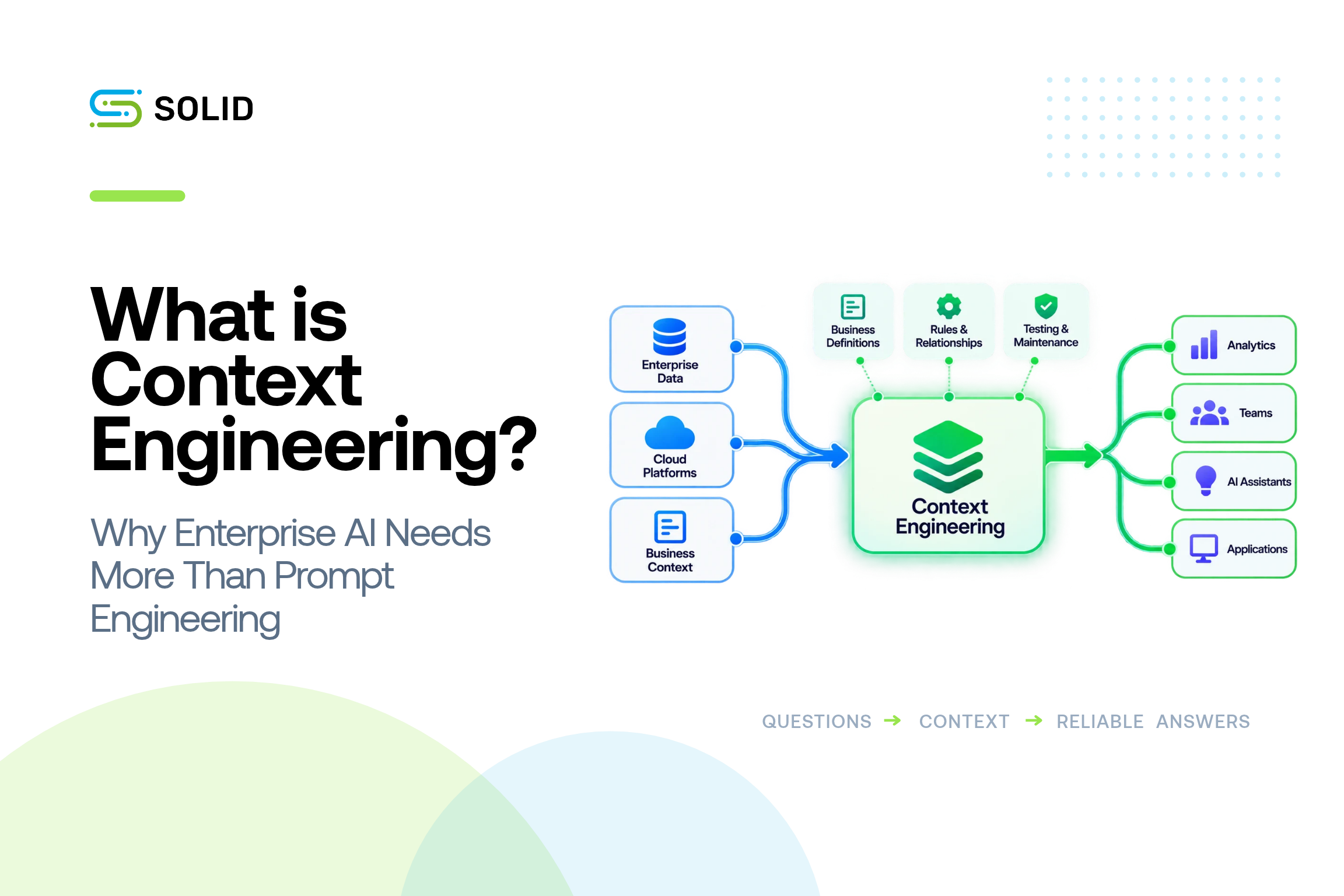
A semantic model provides a structured way to define how company data should be understood. It can capture important metrics, calculations, terminology, and relationships so they can be reused instead of being redefined for every application.
This need for context is also showing up in broader enterprise research. In 2026 research, Gartner identified context, including semantics and metadata, as critical infrastructure for organizations working to scale AI. Gartner also found that organizations reporting successful AI initiatives were investing more heavily in their data and analytics foundations.
That distinction is important. Giving an application access to enterprise data and giving it enough context to work with that data correctly are not the same thing.
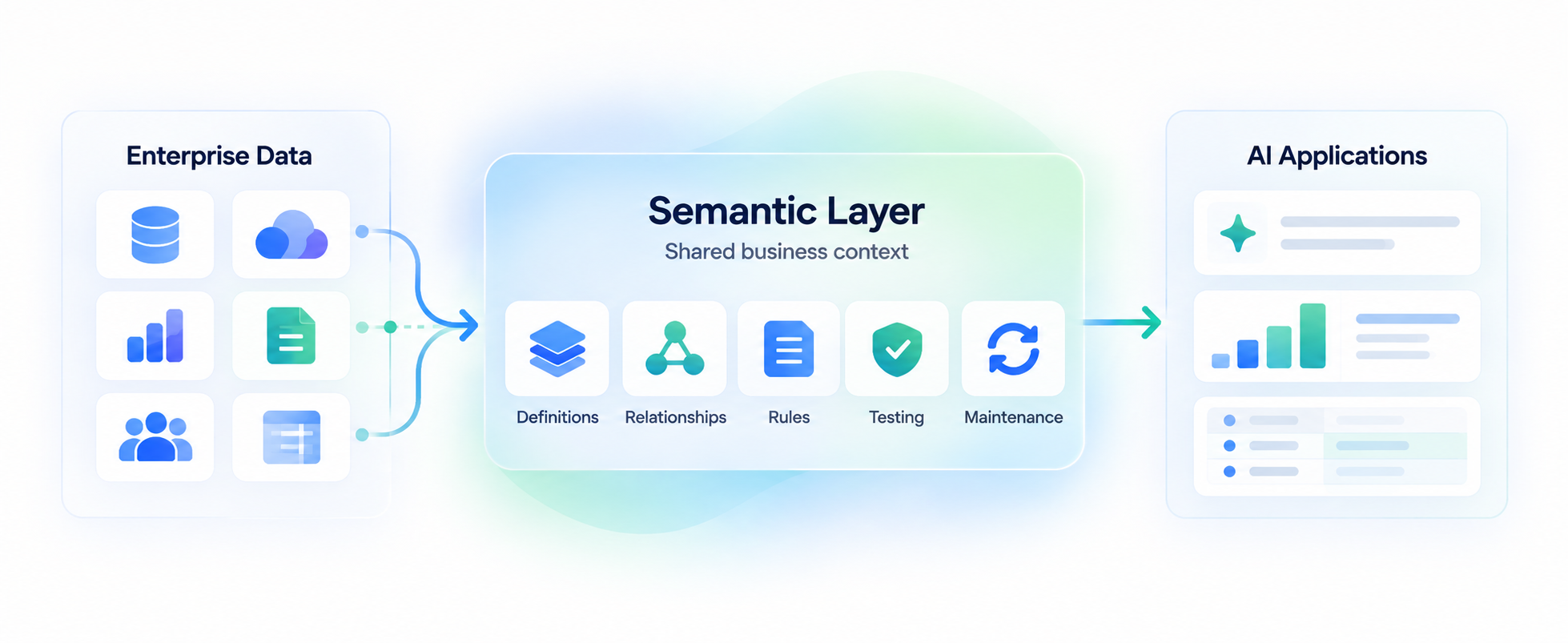
A semantic model can include:
- Metrics: What revenue, churn, retention, pipeline, and other measures mean
- Calculations: How those metrics should be calculated
- Relationships: How customers, accounts, products, orders, and transactions connect
- Terminology: What company-specific terms mean
- Rules: Which filters, exclusions, or conditions apply
- Sources: Which underlying data supports those definitions
For example, instead of requiring every application to determine how “total revenue” should be calculated, the semantic model can define the metric and connect it to the appropriate underlying data.
The same idea applies to relationships.
Instead of expecting an application to figure out how customers, accounts, and orders connect every time it needs an answer, those relationships can be represented in the semantic model.
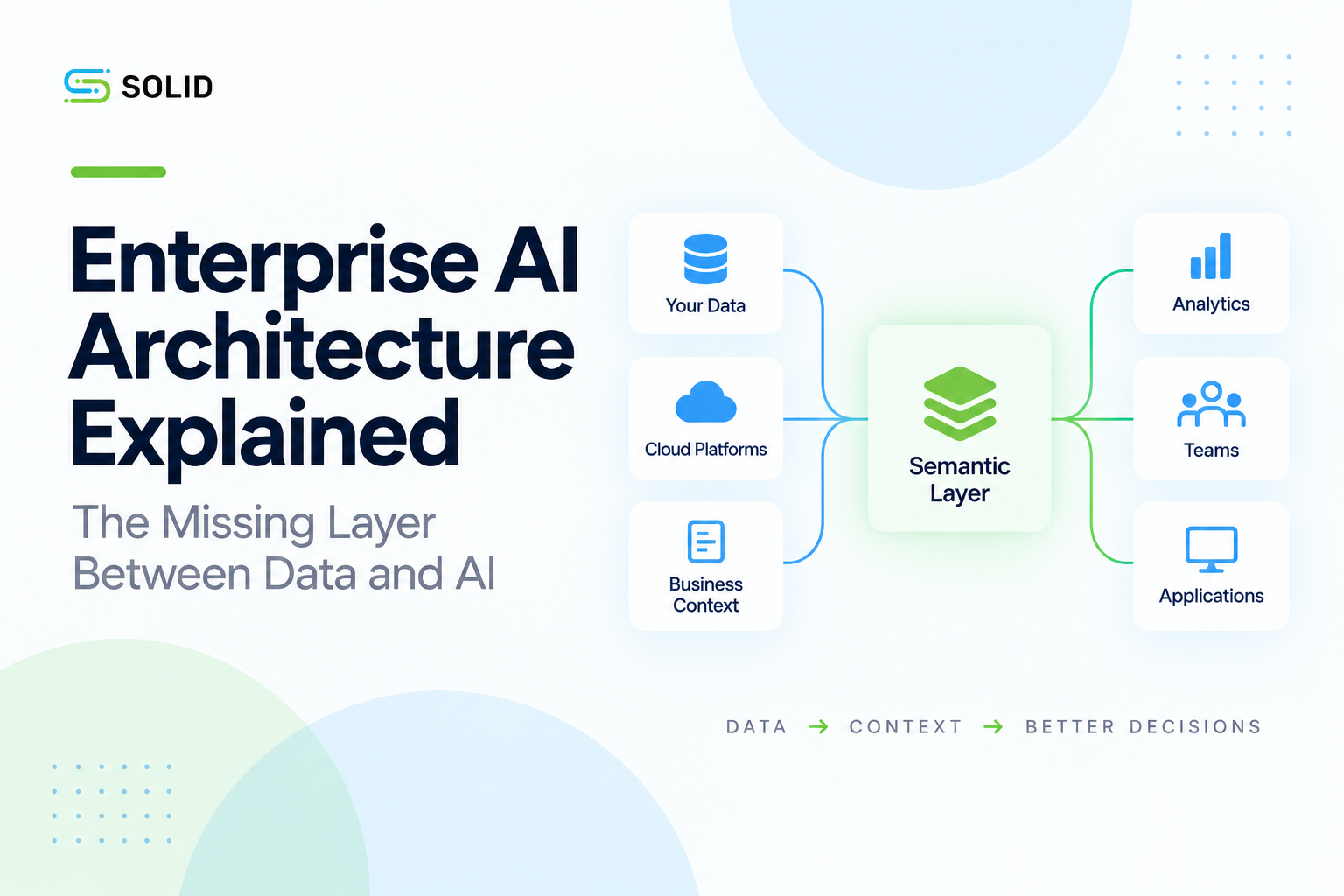
This creates a shared layer of meaning between physical data and the applications using it.
But creating that layer is only the beginning.
Semantic Models Need to Change With the Company
A semantic model reflects how an organization defines and uses its data at a particular point in time.
Then the company changes.
A new source is added. A table changes. Finance updates a calculation. Sales introduces new pipeline stages. A product team changes how customer activity is measured.
Those changes can affect the model.
That creates three ongoing parts of the work:
- Build: Create and expand semantic models as data and definitions are added
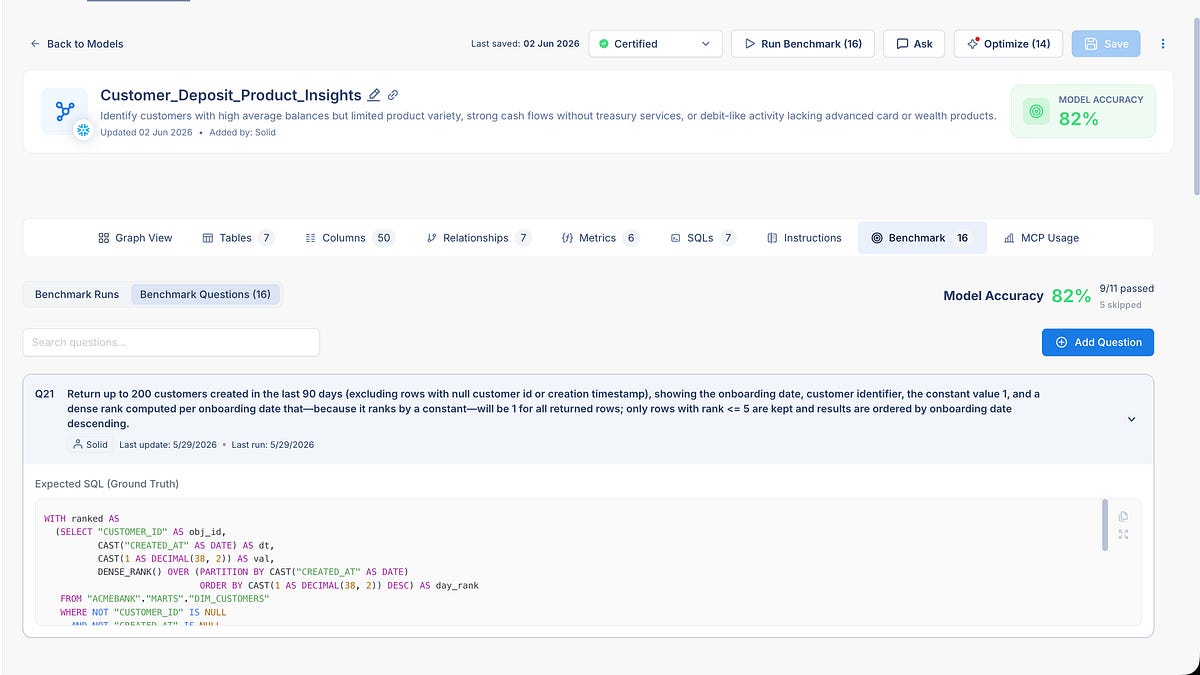
- Test: Validate that the model produces expected results and catch problems when changes are made
- Maintain: Keep definitions, relationships, and calculations current as the company and its data change
Testing and iteration are already part of established semantic modeling practices. A model needs to reflect the way the organization currently uses its data, not simply the way that data was defined when the model was first created.
Without ongoing maintenance, an older definition or relationship can remain in the model even after the company has moved on.
How Solid Helps Data Teams Manage This
Building a semantic model is one part of the work. Keeping it accurate as the company’s data and definitions change is another.
Solid helps reduce much of that manual work by supporting the workflows needed to build, test, and maintain semantic models around the company’s existing data environment.
That includes helping teams:
- Generate semantic models from existing enterprise data
- Define and manage metrics, relationships, and company-specific terminology
- Automate testing to validate expected results
- Identify gaps or inconsistencies that need attention
- Keep semantic models updated as data and requirements change
The goal is to reduce the manual work required to keep business context accurate and usable as the underlying data changes.
Getting Enterprise AI Right Starts Below the Application
When an enterprise AI project starts producing inconsistent answers, changing the model may not address what actually went wrong.
The issue could be that:
- Two teams define the same metric differently
- An important calculation only exists inside a dashboard
- A relationship between tables is missing or incorrect
- An older definition is still being used
- A change was made without testing its impact elsewhere
These are data modeling and management problems that existed before enterprise AI.
What has changed is how many applications are now being asked to work directly with that data and how much company-specific knowledge those applications may need to use it correctly.
Data quality and availability remain major challenges for organizations implementing AI. Making enterprise data useful for these applications also requires the definitions, relationships, and logic around that data to be clear, current, and available where they are needed.
A better model can solve some problems. Others have to be solved closer to the data.
That is where semantic modeling, and the work of building, testing, and maintaining those models, becomes an important part of the enterprise AI stack.
See how Solid helps enterprises build and maintain trusted business context for AI →
Frequently Asked Questions About Enterprise AI Projects
Why do enterprise AI projects fail?
There is no single reason enterprise AI projects fail. Challenges can include data quality and availability, security, integration, unclear use cases, governance, cost, organizational readiness, and problems moving from testing into production.
For applications that rely heavily on enterprise data, inconsistent definitions, relationships, and reporting logic can also affect the quality and consistency of the results.
Why can an AI application give the wrong answer when the underlying data is correct?
Correct data can still be used incorrectly.
If an application uses the wrong definition, calculation, reporting period, relationship, source, or filter, it can work with valid data and still produce a result that does not match the organization’s expected answer.
Can a better AI model fix inconsistent enterprise data?
A more capable model can improve how information is interpreted, but it does not automatically establish a company’s approved definitions, calculations, or reporting rules.
Those need to be defined and made available to the systems using the data.
What is a semantic model?
A semantic model provides a structured representation of how data should be understood.
It can define metrics, dimensions, calculations, terminology, entities, and relationships between data so those concepts can be used consistently by compatible analytics and AI applications.
Why are semantic models important for enterprise AI?
Enterprise databases are designed around tables, columns, and relationships that may not match the language employees use when asking questions.
A semantic model creates a layer between that physical structure and the applications using the data. It provides definitions and relationships that help those applications interpret the underlying information more consistently.
Why do semantic models need to be tested and maintained?
The data environment changes over time. Sources are added, schemas change, definitions evolve, and reporting requirements are updated.
Testing helps teams check whether a semantic model continues to produce expected results. Maintenance keeps its definitions and relationships aligned with the current data environment.
How does Solid help with enterprise AI?
Solid helps data teams build, test, and maintain semantic models around their existing data environment.
This helps teams manage the definitions, relationships, and logic that analytics and AI applications rely on as enterprise data changes.
Sources
Gartner, “Gartner Survey Finds 45% of Organizations With High AI Maturity Keep AI Projects Operational for at Least Three Years,” June 30, 2025.
Gartner, “Gartner Says Organizations With Successful AI Initiatives Invest Up to Four Times More in Data and Analytics Foundations,” April 16, 2026.
Other posts