Blog
August 20, 2026
The Missing Layer in Modern Analytics: AI Agents

Blair King Bader
Marketing Manager
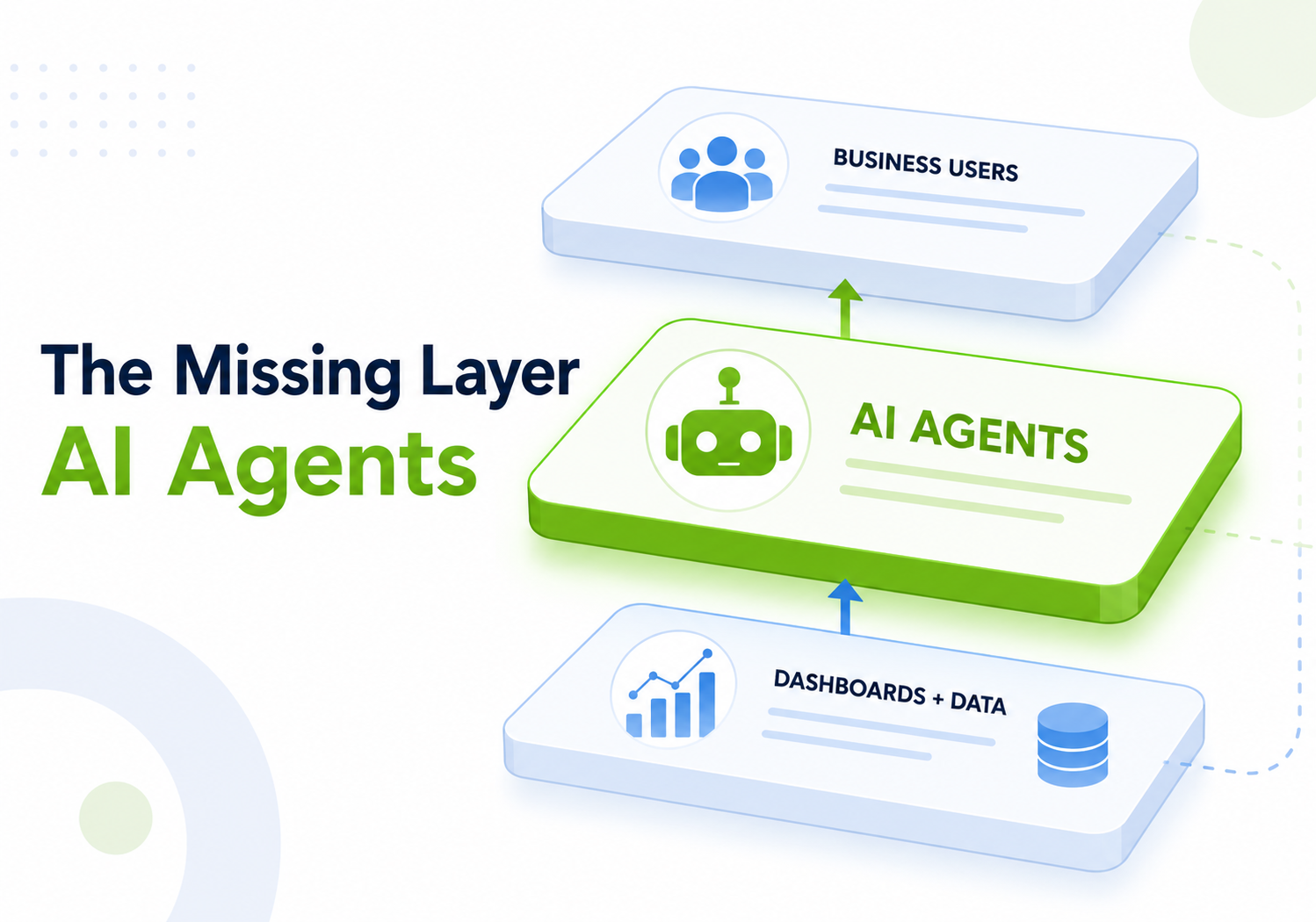
Dashboards help monitor performance, and conversational analytics helps answer questions—but there's a growing need for something in between. This article explores why AI agents are emerging as a new layer in modern analytics, proactively analyzing data, surfacing insights, and helping organizations scale decision-making.
For the past year, most conversations about the future of analytics have focused on two experiences: dashboards and chat.
On one side are traditional BI platforms, where users consume dashboards, monitor KPIs, and track business performance. On the other are conversational analytics tools that allow users to ask questions in natural language and receive answers on demand.
Both represent important parts of the future analytics stack. Yet as organizations move from experimentation to production, many are discovering a gap between the two.
Dashboards are excellent for monitoring. Conversational analytics is powerful for exploration. But neither fully addresses a large category of work that happens every day inside data-driven organizations.
That's where AI agents are beginning to emerge.
The Work Between Dashboards and Chat
Much of enterprise analytics isn't about monitoring metrics or asking one-off questions. It's about recurring analysis.
Every week, sales leaders review pipeline performance. Customer success teams evaluate account health. Operations leaders look for anomalies. Executives prepare for business reviews. Analysts spend countless hours answering variations of the same questions, gathering context, identifying trends, and packaging findings for stakeholders.
Historically, these workflows have been difficult to automate.
Dashboards can display information, but they don't interpret it. They can tell you that churn increased, but they don't explain why. Conversational analytics can help users investigate, but it still requires someone to initiate the process and know what questions to ask.
Many organizations are realizing that there's a third category of analytical work that sits between those two experiences.
Why Dashboards Aren't Enough
Business intelligence platforms were built around the assumption that users would regularly consume information and draw their own conclusions.
For many use cases, that remains true. Executive scorecards, operational KPIs, and regulatory reporting all benefit from standardized dashboards that provide a consistent view of the business.
The challenge is that modern organizations generate far more data than any individual can reasonably monitor.
When performance shifts unexpectedly, important insights often remain buried inside dashboards until someone notices them. Valuable opportunities may exist in the data, but discovering them requires time, expertise, and attention that many teams simply don't have.
This is one reason why organizations continue to invest heavily in analysts. The value isn't just the data itself. The value is the interpretation.
Why Chat Isn't Enough Either
Conversational analytics addresses a different challenge by making data more accessible. Instead of navigating reports or writing queries, users can simply ask questions.
This represents a meaningful improvement in usability, but it introduces its own limitation.
Most users don't wake up knowing exactly what questions they should ask.
If revenue declines unexpectedly, what is the first question? Which segment should be investigated? Which region matters most? Which operational change may have contributed?
Effective analysis is often driven by context rather than curiosity alone.
As a result, many organizations are finding that simply providing a chat interface doesn't automatically lead to better decisions. Users still need guidance on where to focus their attention.
The Rise of AI Agents
This is where AI agents are beginning to play an important role.
Unlike dashboards, agents don't simply present information. Unlike chat interfaces, they don't wait for users to initiate every interaction.
Instead, agents perform recurring analytical work on behalf of the business.
An agent might analyze pipeline changes before a weekly sales meeting and identify the largest drivers of movement. It might review customer health metrics and flag accounts at risk of churn. It might prepare an executive summary highlighting unusual trends, emerging risks, or operational opportunities.
In each case, the agent is not replacing decision-makers. It's reducing the manual effort required to surface relevant insights.
The result is a more proactive analytics experience.
A More Complete Analytics Stack
As organizations mature their AI strategies, the future analytics stack is starting to look less like a replacement story and more like an expansion story.
Dashboards remain essential for monitoring performance and creating alignment around key metrics.
Conversational analytics enables users to explore data, investigate issues, and ask follow-up questions.
AI agents provide a layer of ongoing analysis that continuously evaluates information and surfaces insights without requiring constant human intervention.
Each serves a different purpose, and each addresses a different type of business need.
Organizations that focus exclusively on dashboards may struggle to keep pace with growing data complexity. Organizations that focus exclusively on chat may find that users don't always know what to ask. AI agents help bridge that gap by proactively transforming data into actionable context.
The Next Evolution of Analytics
Much of the conversation around AI in analytics has focused on replacing existing tools and workflows. In practice, the most significant opportunity may be augmenting them.
The future of analytics isn't likely to be defined by dashboards or chat interfaces alone. It will be shaped by systems that can monitor performance, investigate changes, and proactively surface insights when they matter most.
That's why AI agents are attracting so much attention. They aren't simply another interface for accessing data.
They represent a new way of delivering analysis itself.
For organizations looking to make analytics more accessible, scalable, and impactful, that may be the missing layer they've been searching for.
Other posts

.png)