Blog
September 8, 2026
AI Agents vs. AI Copilots: Key Differences Explained

Blair Bader
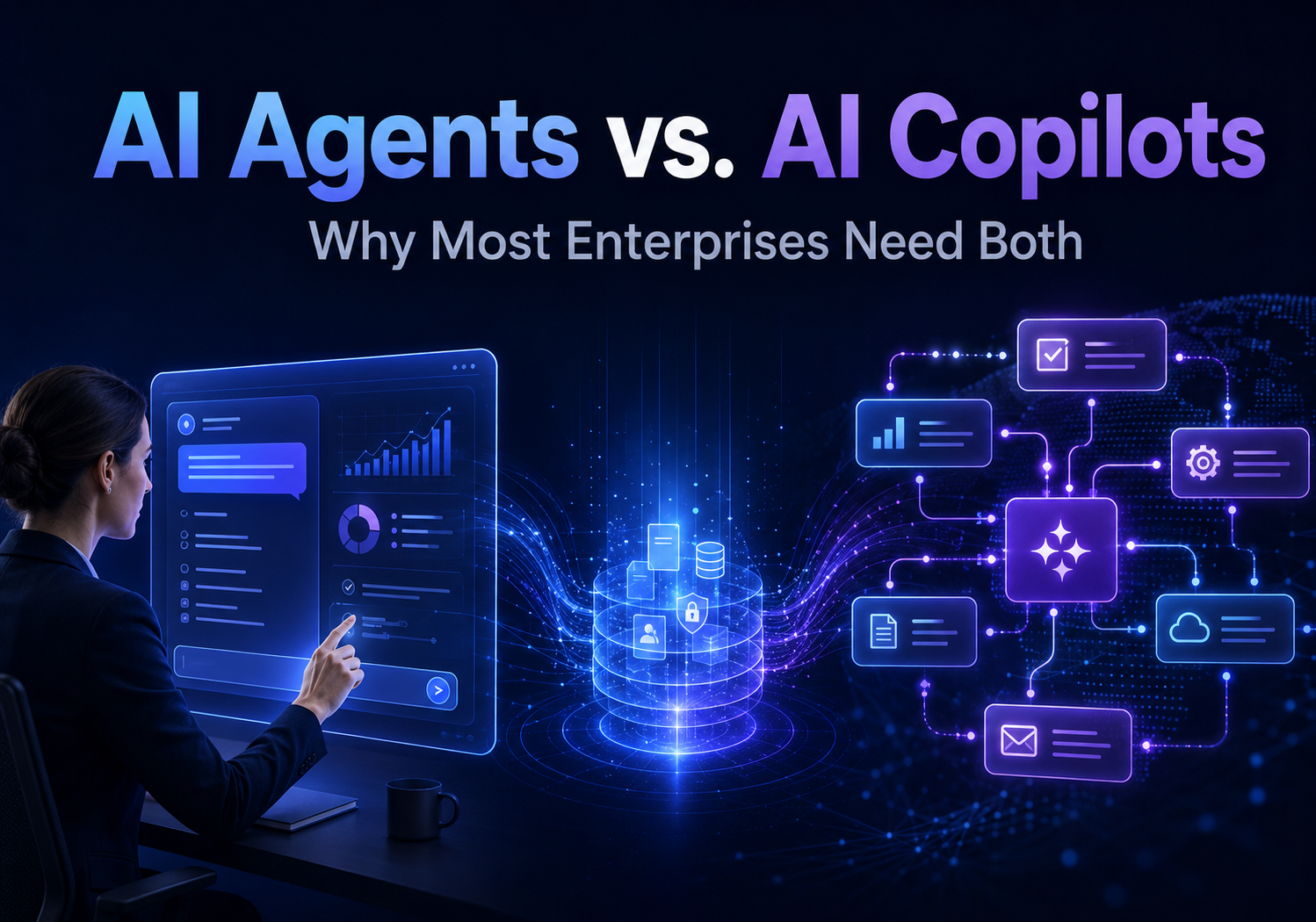
AI copilots help people work faster, while AI agents execute work with greater autonomy. Learn where each fits and why enterprises need both built on trusted business context.
AI copilots and AI agents are often treated as competing visions for the future of enterprise AI. One keeps a person in control. The other promises to complete work autonomously.
But most enterprises do not need to choose between them.
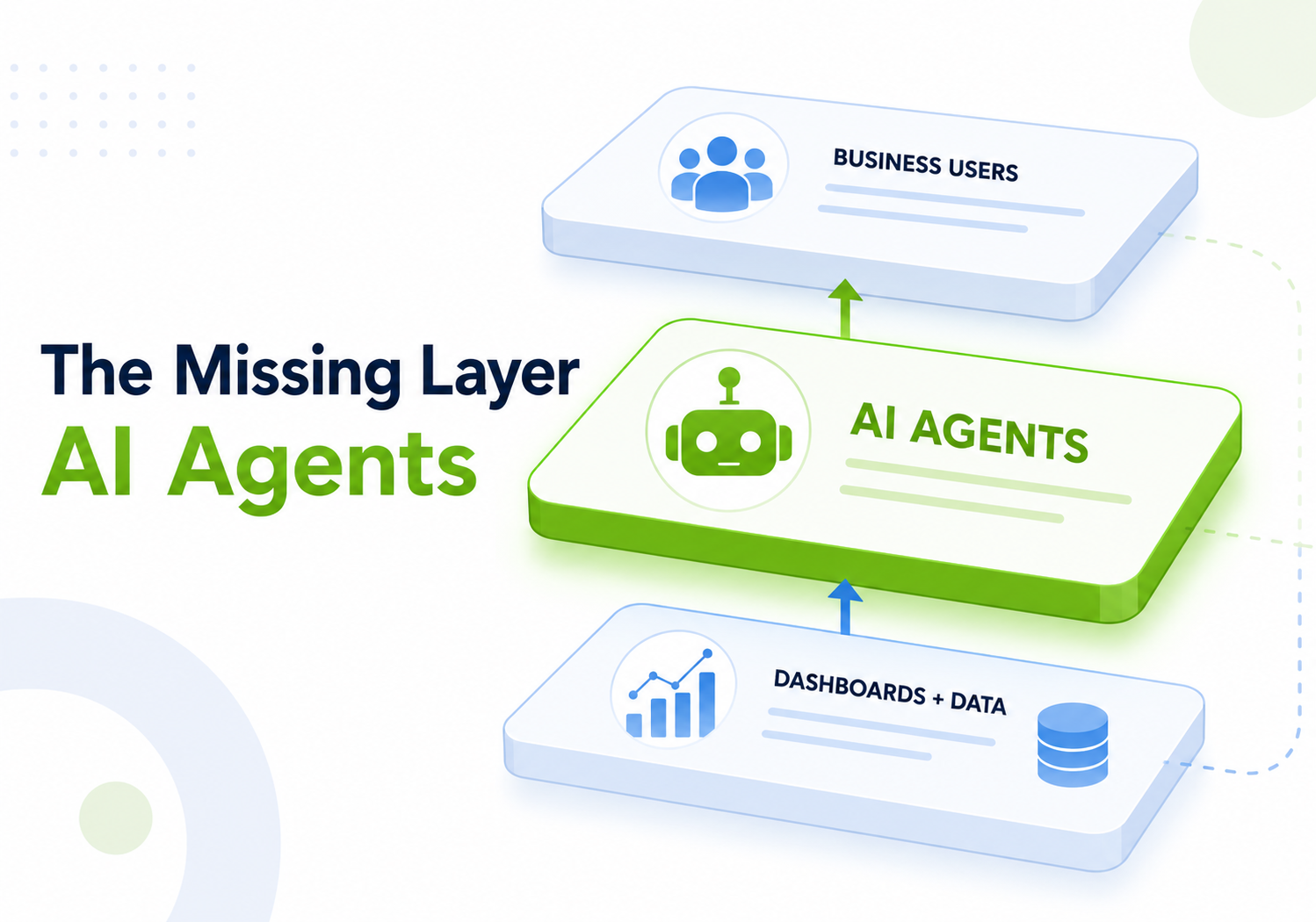
They need copilots for work that depends on human judgment, exploration, and approval. They need agents for repeatable workflows that can be safely delegated. As explored in The Missing Layer in Modern Analytics: AI Agents, agents are becoming a new layer between passive dashboards and user-driven chat. Both agents and copilots need the same foundation: trusted business context that allows AI to understand the company's data, definitions, policies, and processes.
Without that foundation, a copilot helps people reach the wrong answer faster. An agent takes the wrong action without waiting for anyone to notice.
What is the difference between an AI agent and an AI copilot?
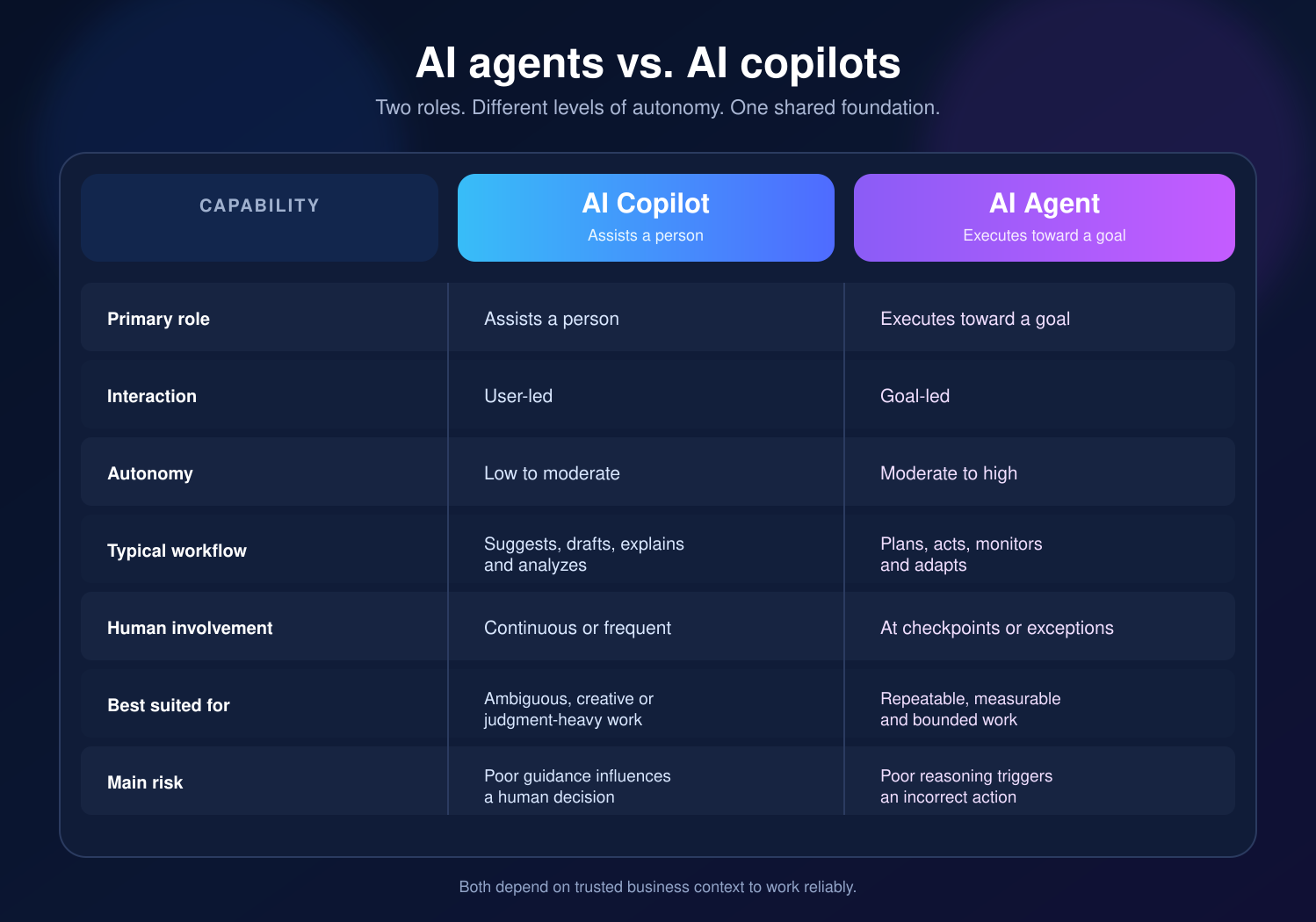
An AI copilot assists a person as they work, while an AI agent works toward a goal with some degree of autonomy.
A copilot responds to a user, provides recommendations, drafts content, analyzes information, or suggests a next step. The person remains responsible for directing the work and deciding what happens next.
An agent can interpret a goal, plan and complete multiple steps, use tools, monitor results, and decide what to do next within defined boundaries. A person establishes the objective and guardrails, but does not need to direct every action.
The simplest distinction is this:
- Copilots help people do work.
- Agents do delegated work on people's behalf.
The boundary is not always clean. A copilot may take actions after receiving approval, and an agent may pause for human review. The meaningful difference is not the interface or the label. It is who drives the workflow, how much autonomy the AI has, and who is accountable at each step. This evolution from assistants toward more autonomous digital coworkers is also explored in From Co-pilots to Colleagues.
AI agents vs. AI copilots at a glance
What is an AI copilot?
An AI copilot is an assistant embedded in a person's existing workflow. It helps the user understand information, create an output, or make a decision, but the user remains in control.
Common enterprise copilot use cases include:
- Helping an analyst explore performance and generate SQL
- Summarizing account history for a sales representative
- Drafting a response for a customer support agent
- Explaining changes in financial or operational metrics
- Helping a developer write, review, or debug code
- Surfacing relevant policies while an employee completes a task
Copilots are especially useful when the work is difficult to define in advance. A business leader investigating a drop in revenue may ask a series of questions, change direction as new information appears, and apply knowledge that is not captured in a system. The AI accelerates the investigation, but the human supplies the intent and judgment.
That human involvement is not a temporary limitation. In many workflows, it is the right design.
What is an AI agent?
An AI agent is a system that can pursue an objective and perform multiple steps with limited human direction. Depending on its role and permissions, an agent may gather information, reason about it, use enterprise tools, trigger actions, monitor outcomes, and escalate exceptions.
Common enterprise AI agent use cases include:
- Monitoring pipeline activity and flagging deals that require attention
- Investigating changes in key business metrics
- Preparing recurring business reviews using current data
- Resolving routine IT or customer support requests
- Identifying inventory risks and initiating approved workflows
- Checking data quality, detecting drift, and routing issues to owners
An agent does not have to operate without oversight. In a well-designed enterprise workflow, autonomy is graduated. The agent may complete low-risk steps independently, request approval for high-impact actions, and send unfamiliar situations to a person.
The goal is not to remove humans from every process. It is to remove unnecessary human coordination while preserving control where it matters.
Why enterprises need both AI agents and AI copilots
Enterprise work does not fall into a single category. Some work benefits from real-time human collaboration. Some is structured enough to automate. Much of it moves between the two.
Consider a revenue decline.
A copilot can help a business leader explore the problem: Which region changed? Was the decline caused by fewer customers, lower order values, or delayed renewals? The leader can ask follow-up questions and apply context that may not exist in the data.
An agent can handle the repeatable work around that investigation. It can monitor revenue, detect an unusual change, compare it with prior periods, identify the affected segment, prepare a briefing, and notify the right team. If the issue meets predefined conditions, it can initiate a follow-up workflow.
The copilot supports judgment. The agent reduces the delay between signal and action. This is similar to the broader shift described in The Future of BI Isn't Dashboards vs. AI—It's Which Questions Deserve Each: the best experience depends on the type of question and work involved.
Used together, they create a more practical operating model:
- Agents continuously monitor and execute routine work.
- Copilots help people investigate, decide, and handle exceptions.
- Humans approve consequential actions and refine the operating rules.
- Agents carry the decision back into the workflow and continue monitoring.
This combination is more valuable than forcing every use case into a chat interface—or trying to automate every decision from the start.
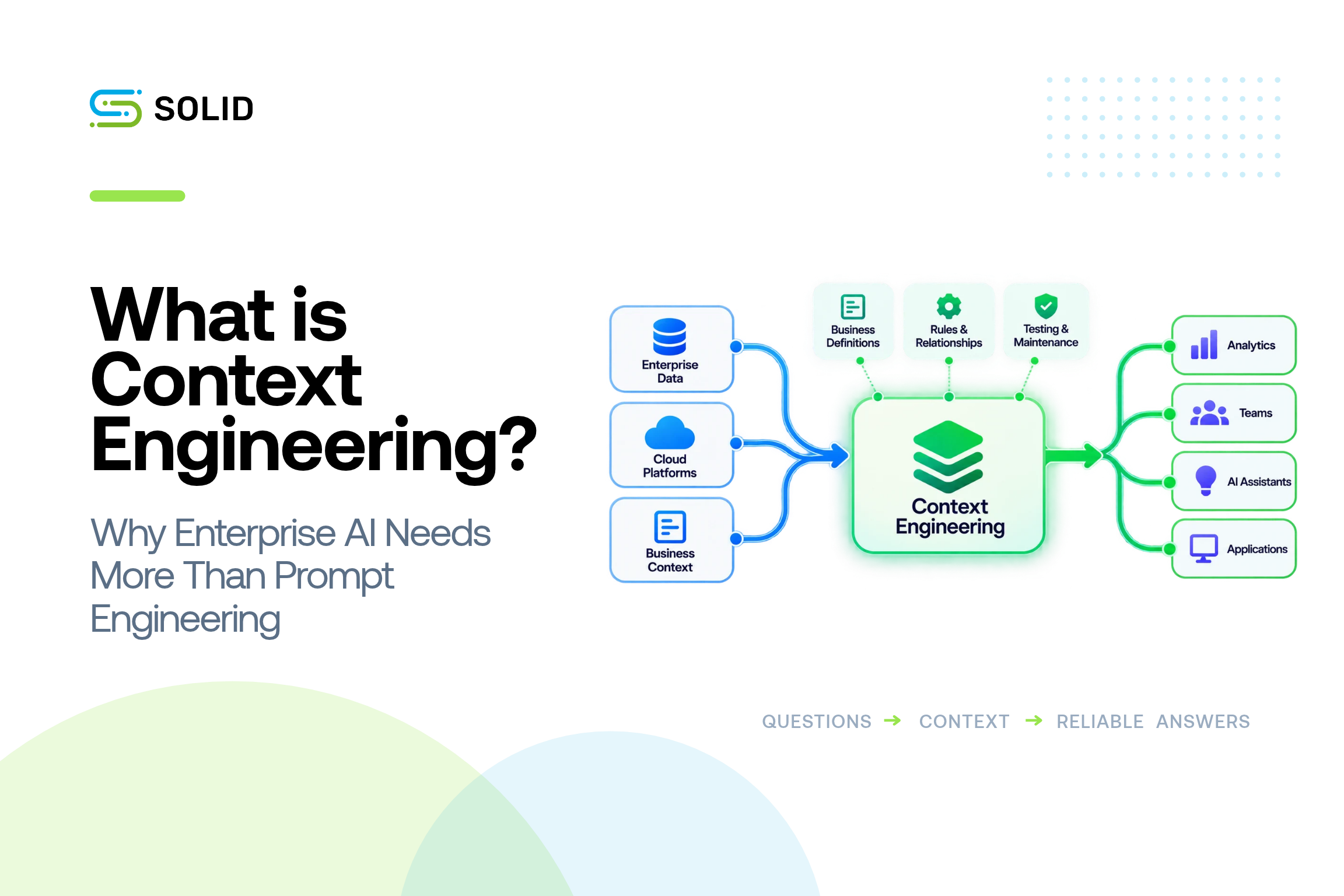
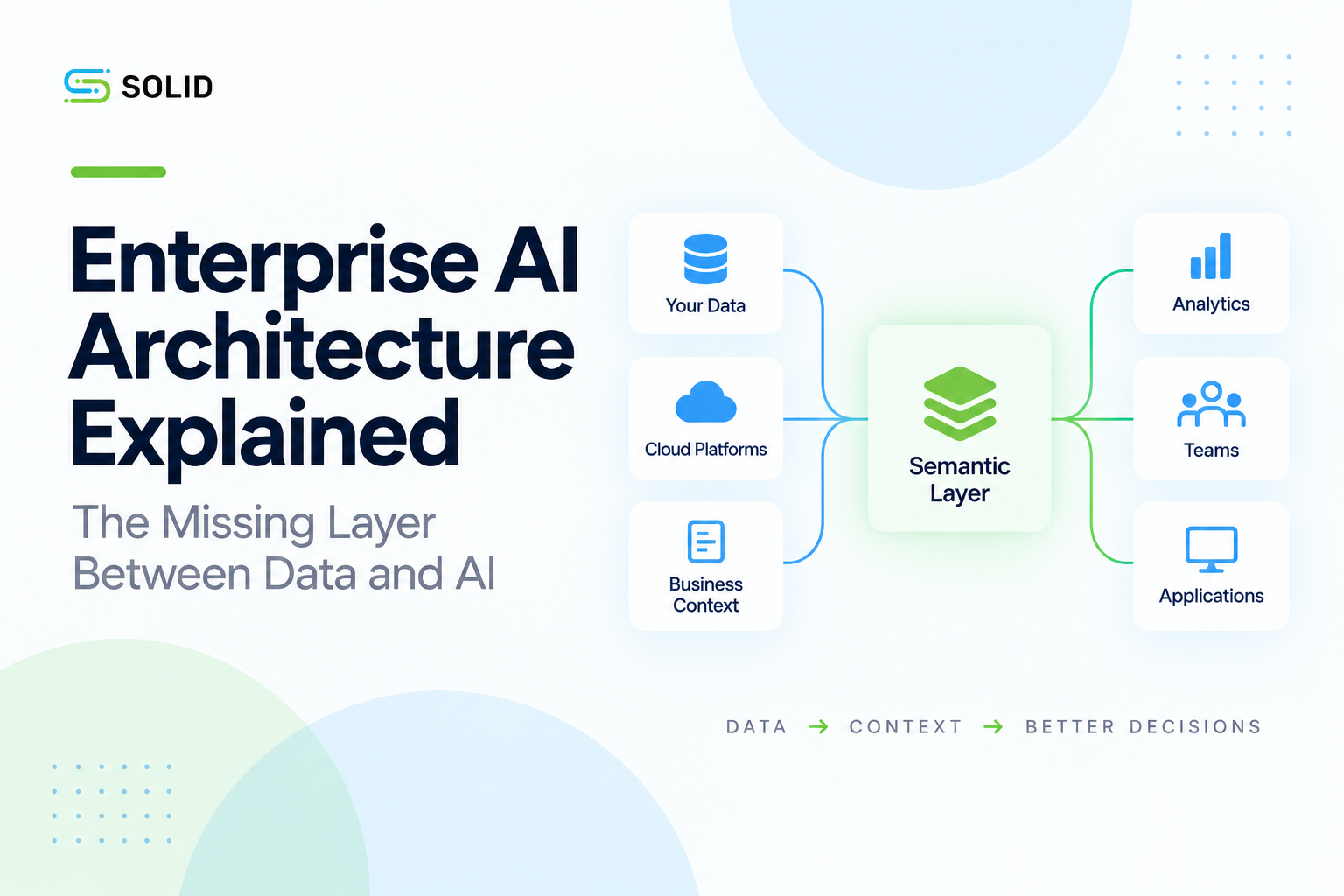
The real challenge is not the interface. It is context.
Enterprises often begin by evaluating models, interfaces, or agent frameworks. But the hardest problem appears when AI has to understand the business itself. That is why semantic modeling has become foundational for trusted analytics and AI.
What does “revenue” mean at this company? Which customers count as active? Does “this year” mean the calendar year or fiscal year? Which source should be used when two systems disagree? Who is allowed to see a particular segment? What conditions require approval?
A human employee learns these rules through experience, documentation, conversations, dashboards, and corrections. An AI system needs them to be explicit, accessible, and consistent.
This becomes more important as autonomy increases.
If a copilot misunderstands a metric, a person may catch the error before acting. If an agent misunderstands the same metric, it may produce a report, notify an executive, update a system, or trigger another workflow before the mistake is reviewed.
The move from copilots to agents therefore raises the standard for enterprise context. Agents need more than access to tables and documents. They need a trusted understanding of:
- Business metrics and how they are calculated
- Entities and relationships across systems
- Approved data sources and precedence rules
- Time, geography, and organizational conventions
- Permissions, policies, and action boundaries
- Tests that confirm an answer or action is reliable
This is why the same context layer should support both copilots and agents. Otherwise, every AI application recreates business logic, produces different answers, and requires its own maintenance process. And as Yoni Leitersdorf explains in Your Data Agents Need Context. But Context Is Not Enough, that context cannot be a static snapshot; it must be continuously generated, refined, corrected, and updated as the business changes.
When should an enterprise use a copilot?
Use a copilot when the human should remain the primary decision-maker or when the workflow changes significantly from one situation to another.
A copilot is usually the better fit when:
- The request is exploratory or open-ended
- The work depends heavily on human judgment
- The cost of an incorrect action is high
- The user needs to understand and challenge the reasoning
- The workflow is new and its patterns are still being discovered
- The AI should recommend an action rather than take it
Copilots are also a useful starting point for new AI use cases. They allow an enterprise to observe how people use the system, where errors occur, and which parts of the workflow become predictable enough to delegate later. This distinction matters because not every question AI can answer should be answered dynamically; enterprises should choose the experience that creates the most business value.
When should an enterprise use an AI agent?
Use an AI agent when the objective is clear, success can be measured, and the system can operate within explicit boundaries.
An agent is usually the better fit when:
- The workflow is repeatable and time-sensitive
- Inputs and acceptable actions can be defined
- The AI needs to coordinate multiple tools or steps
- Delays caused by manual handoffs are expensive
- Results can be tested or monitored
- Exceptions can be routed to a responsible person
The strongest early agent use cases are rarely “run the entire business.” They are bounded workflows with clear inputs, actions, and escalation paths. The lesson from Why AI Fails When It Ignores the Workflow is especially relevant here: successful enterprise AI starts by understanding how work actually happens, not by adding a chatbot to a broken process.
How to decide what to build first
Start with the work, not the AI category.
For each use case, ask four questions:
- Who should drive the workflow? If a person should direct each step, begin with a copilot. If the system can pursue a stable goal, consider an agent.
- What happens when the AI is wrong? The greater the impact, the stronger the approval, testing, and escalation requirements.
- Can success be measured? Agents need clear outcomes and observable failure conditions.
- Does the AI have trusted business context? If definitions, relationships, policies, and permissions are inconsistent, solve that problem before increasing autonomy.
Many enterprises will find that the right answer is a progression. Begin with a copilot, learn from real usage, automate the repeatable steps, and gradually increase autonomy as reliability improves. One operator's experience teaching AI agents to run real business workflows shows why this progression requires explicit business logic, ongoing supervision, and clear escalation points (not just a powerful model.)
Trusted context is the foundation for both
AI copilots and AI agents serve different roles, but they cannot operate as separate islands.
Both must understand the same customers, products, metrics, hierarchies, and business rules. Both need answers that remain consistent across warehouses, BI tools, applications, and workflows. And both need that understanding to stay current as the underlying data changes.
Solid provides an AI-native context layer that automatically builds, tests, and maintains trusted business context across enterprise data. Copilots can use that context to give people reliable answers. Agents can use it to reason, make decisions, and act within governed boundaries.
The future of enterprise AI is not copilots or agents. It is people and AI working across different levels of autonomy with a shared understanding of the business underneath them.
Frequently asked questions
Are AI agents replacing AI copilots?
No. AI agents and AI copilots are suited to different types of work. Agents are useful for bounded, repeatable workflows that can be delegated. Copilots are better for exploration, judgment-heavy decisions, and work that requires continuous human direction. Most enterprises will use both.
Is an AI copilot considered an AI agent?
The terms sometimes overlap, but they describe different interaction models. A copilot is primarily user-led and assists with a task. An agent is goal-led and can plan or execute multiple steps with greater autonomy.
What is agentic AI?
Agentic AI refers to AI systems that can pursue goals, make decisions, use tools, and take actions with some degree of autonomy. Enterprise agentic AI typically operates within defined permissions, policies, monitoring, and human escalation paths.
What is the biggest risk of enterprise AI agents?
The biggest risk is allowing an agent to act on incomplete, inconsistent, or incorrect business context. Because agents can take action, small interpretation errors can propagate across systems and workflows. Trusted context, testing, permissions, monitoring, and human oversight are essential.
Can an AI system be both a copilot and an agent?
Yes. A single enterprise AI experience can operate as a copilot during exploration and as an agent for approved execution. For example, it might help a user investigate a revenue issue, recommend a response, request approval, and then carry out the approved workflow.
Build AI that understands your business
Whether your enterprise is deploying copilots, agents, or both, reliability begins with shared business context.
See how Solid gives AI agents and copilots the trusted context they need to answer, decide, and act with confidence. Book a demo.
Other posts

.png)
.png)