Blog
September 1, 2026
Semantic Modeling Tools vs Semantic Layers in 2026

Blair Bader
Compare the leading semantic modeling tools and semantic layer platforms for enterprise AI in 2026.
When your AI returns different revenue numbers depending on which tool asked the question, you've got a problem. That's why the choice between semantic modeling tools and semantic layer platforms has become one of the most important architectural decisions for enterprise data teams in 2026.
This comparison breaks down the real differences between these two approaches, covering how they handle BI integration, metrics standardization, automation, and text-to-SQL reliability. You'll walk away knowing which solution fits your enterprise AI strategy.
Key Takeaways: Solid Data AI Platform vs Cube, dbt Labs, AtScale, Databricks Genie, and Collibra
- Solid Data AI Platform automates semantic model generation from your existing BI schemas, reducing manual effort by 90-95%.
- Semantic layer platforms like Cube and dbt Labs require significant upfront modeling work before delivering value.
- Databricks Genie and AtScale offer warehouse-native approaches that work well for single-platform teams.
- Collibra focuses on data governance and cataloging rather than automated semantic model creation.
- The Solid Data AI Platform combines automation with built-in validation, giving you reliable text-to-SQL from day one.
Solid Data AI Platform vs Cube vs dbt Labs vs AtScale vs Databricks Genie vs Collibra: Overview
What is Solid Data AI Platform?
The Solid Data AI Platform is an AI-powered data platform that maps, translates, and validates enterprise data into consistent, business-ready semantic definitions. It serves as a reliable foundation for analytics and AI applications by automatically building and maintaining AI-ready semantic models from your existing data sources.
Solid Data AI Platform key features
- Semantic Model Generator: Auto-creates semantic models including tables, metrics, relationships, and SQL based on real usage patterns.
- Solid Analyze: Enterprise text-to-SQL engine that turns business questions into trusted queries powered by a context graph.
- Solid Router Mode: Automatically selects the most relevant certified semantic model and returns a single executable SQL query.
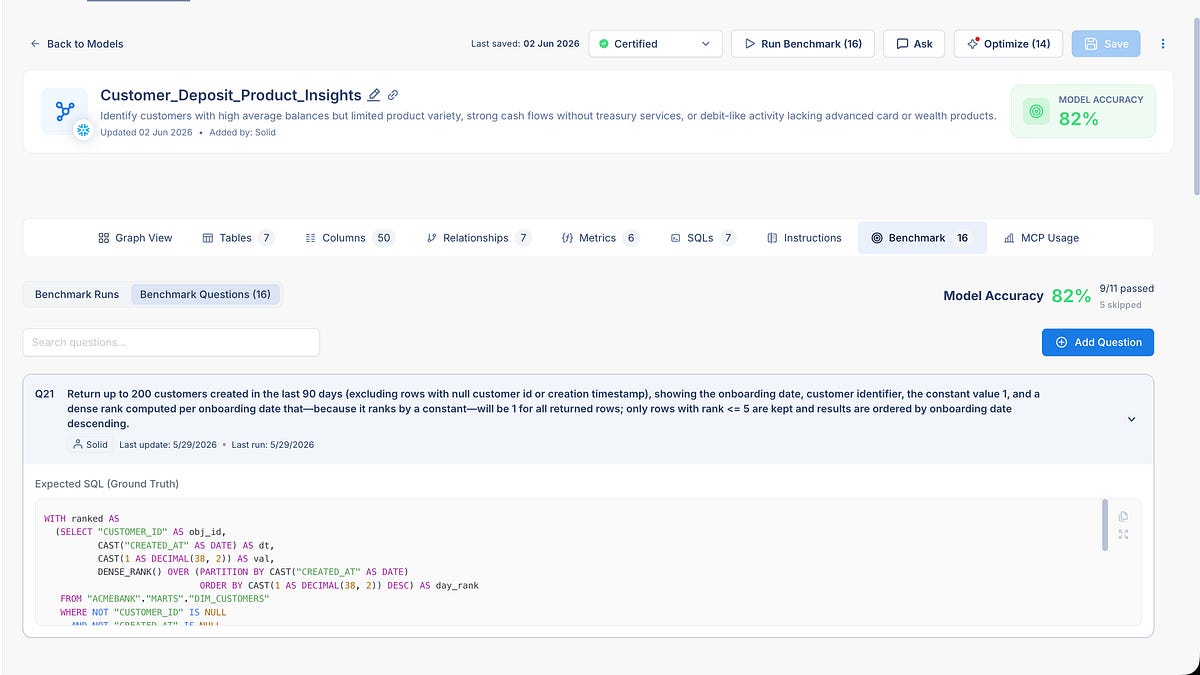
- Built-in validation: Edit, test, and validate models directly in Solid, keeping data teams in control of accuracy.
- Universal export: Power any AI interface including Snowflake Cortex, Databricks Genie, ChatGPT, and dbt with reliable semantic models.
Solid Data AI Platform pros and cons
Pros:
- Reduces manual semantic modeling effort by 90-95%, getting you to production in weeks instead of months.
- Built-in validation ensures your models are tested before deployment, eliminating blind trust in auto-generated outputs.
- Delivers 2.5x more accurate results than competitors in side-by-side evaluations using the same data and business questions.
Cons:
- Requires initial connection setup to your data warehouse and BI tools, though no migration is needed.
- Teams accustomed to manual modeling may need time to trust automated outputs, though validation features help build confidence.
- Advanced customization options may take additional exploration for teams with highly specialized requirements.
What is Cube?
Cube is an open-source semantic layer platform that sits between your warehouse and applications, exposing governed metrics through REST, GraphQL, and SQL APIs with built-in caching and pre-aggregations. The platform uses a code-first development model where cubes are defined in JavaScript or YAML.
Cube key features
- API-first architecture: Offers REST, GraphQL, SQL, and Python APIs for flexible application integration.
- Pre-aggregation caching: Computes and maintains common metric combinations for faster query performance.
- Row-level security: Supports multi-tenant access control for embedded analytics use cases.
- Open-source core: Cube Core is Apache 2.0 licensed, allowing self-hosted deployments.
- MCP server support: Native Model Context Protocol integration for AI agent access to governed metrics.
Cube pros and cons
Pros:
- Open-source core allows organizations to deploy on-premises or in private clouds without vendor lock-in.
- API-first design makes it suitable for teams building custom analytics applications or embedded analytics.
- Active community and documentation support teams during implementation.
Cons:
- Requires significant engineering effort to define metrics, joins, and access rules before the system becomes useful.
- No visual modeling interface means nontechnical business users cannot author definitions independently.
- Self-hosted deployments require managing infrastructure, scaling, and upgrades internally.
What is dbt Labs?
The dbt Semantic Layer, powered by MetricFlow, extends dbt from a transformation tool into a governed metrics platform. Metrics are defined in YAML alongside your dbt models, and MetricFlow generates the SQL for every downstream tool automatically.
dbt Labs key features
- Metrics-as-code: Define metrics in YAML files colocated with dbt models for version-controlled governance.
- Git-based workflows: Enables collaborative development through pull request reviews and CI/CD pipelines.
- Warehouse-agnostic: Integrates with Snowflake, BigQuery, Databricks, Redshift, and other platforms.
- BI tool integrations: Connects with Tableau, Power BI, Hex, Mode, and other analytics tools.
- MetricFlow engine: Compiles metric definitions into optimized SQL automatically.
dbt Labs pros and cons
Pros:
- Natural fit for analytics engineering teams already invested in dbt for data transformation.
- Version-controlled metric definitions enable auditability and rollback capabilities.
- MetricFlow's open-source core gives teams visibility into how SQL is generated.
Cons:
- Requires dbt Cloud for the managed Semantic Layer, limiting options for dbt Core users.
- No built-in pre-aggregation cache means all queries execute directly against the warehouse.
- YAML authorship has a learning curve for teams new to semantic layer concepts.
What is AtScale?
AtScale is an enterprise semantic layer platform focused on large organizations in banking, healthcare, retail, and the Fortune 500. It offers a semantic modeling environment where business analysts define logic using a visual design canvas, then a query engine transforms incoming queries into optimized warehouse queries.
AtScale key features
- Visual design canvas: Drag-and-drop interface for defining tables, relationships, and conformed dimensions.
- Autonomous aggregates: Query optimizer automatically recognizes and uses pre-computed aggregates for performance.
- MDX/DAX support: Live connectivity to Excel and Power BI for spreadsheet-heavy organizations.
- Fine-grained security: Row-level, column-level, and object-level security for federated governance.
- MCP support: Exposes semantic definitions through Model Context Protocol for AI agent integration.
AtScale pros and cons
Pros:
- Mature platform with extensive enterprise deployment experience across regulated industries.
- Serves Power BI, Tableau, Excel, and Looker simultaneously from one governed layer.
- Aggregate awareness delivers sub-second query performance across large datasets.
Cons:
- Represents additional infrastructure requiring separate deployment and operational expertise.
- Implementation timelines are longer compared to automated solutions.
- Oriented toward large enterprises rather than mid-market organizations.
What is Databricks Genie?
Databricks Genie is a conversational analytics interface that lets business users ask questions in natural language and receive answers grounded in data from the Databricks lakehouse. It connects to Databricks Metric Views defined in Unity Catalog to maintain governed definitions.
Databricks Genie key features
- Natural language interface: Business users ask questions conversationally without writing SQL.
- Unity Catalog integration: Uses governed metric definitions and lineage from Databricks' data catalog.
- Metric Views: Separates measure definitions from dimension groupings for flexible querying.
- Row-level security: Inherits access controls from Unity Catalog at query time.
- Lakehouse-native: Runs directly on Databricks without requiring additional infrastructure.
Databricks Genie pros and cons
Pros:
- No additional infrastructure needed for teams already running Databricks.
- Native governance integration with Unity Catalog simplifies access management.
- Metric Views being open-sourced into Apache Spark increases portability.
Cons:
- Limited to the Databricks ecosystem, requiring alternative solutions for multi-warehouse environments.
- Metric Views are relatively new compared to dedicated semantic layer platforms.
- Does not address semantic modeling automation or generation from existing BI schemas.
What is Collibra?
Collibra is a data intelligence platform focused on data cataloging, governance, and stewardship. Its semantic layer capabilities support building relationships between business terms and technical data assets through guided stewardship workflows.
Collibra key features
- Data catalog: Centralized inventory of data assets with automated metadata discovery.
- Business glossary: Define and govern business terms with relationships to technical data.
- Guided stewardship: Workflow-driven approach to building and maintaining semantic relationships.
- Data lineage: Visual tracking of data flows from source systems to reports.
- Policy management: Define and enforce data governance policies across the organization.
Collibra pros and cons
Pros:
- Data governance capabilities support organizations with complex regulatory requirements.
- Business glossary helps align technical and business stakeholders on terminology.
- Lineage visualization helps data teams understand data dependencies.
Cons:
- Focuses on governance and cataloging rather than automated semantic model generation.
- Semantic layer capabilities require manual definition rather than automation from usage patterns.
- Does not include text-to-SQL or query generation capabilities native to the platform.
Solid Data AI Platform vs Cube vs dbt Labs vs AtScale vs Databricks Genie vs Collibra: In-depth comparison
Semantic model automation
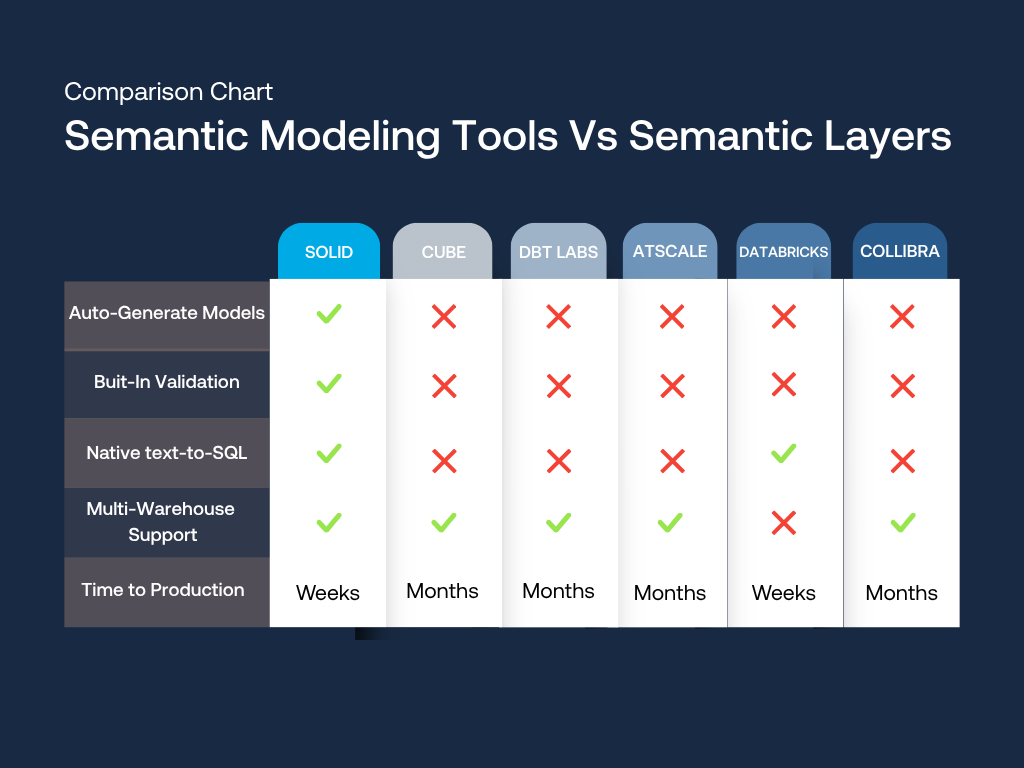
The Solid Data AI Platform auto-generates semantic models from your existing data warehouse and BI tools, including tables, metrics, relationships, and SQL based on actual usage patterns. This approach reduces manual effort by 90-95% while ensuring models reflect how your business actually operates.
Cube, dbt Labs, and AtScale all require manual definition of metrics, joins, and relationships before the semantic layer becomes useful. Databricks Genie relies on Metric Views that must be created manually, while Collibra focuses on governance rather than model generation.
Text-to-SQL reliability
Solid Data's text-to-SQL engine uses a context graph of your data and metrics to generate correct, executable queries automatically. In benchmarks using real customer semantic models, Solid outperformed competitors by 25% on business question accuracy.
Both dbt Labs and Databricks Genie report improved text-to-SQL accuracy when grounded in semantic definitions compared to raw schema queries. However, their accuracy depends entirely on the quality and completeness of manually-created semantic models. Cube and AtScale expose metrics for AI consumption but don't include native text-to-SQL capabilities.
BI tool integration
The Solid Data AI Platform exports semantic models to Snowflake Cortex, Databricks Genie, ChatGPT, dbt, and other AI and BI tools without requiring changes to your existing stack. Your tools stay up-to-date automatically with consistent, business-aware definitions.
AtScale offers the widest BI tool coverage with native MDX/DAX support for Excel and Power BI, plus connections to Tableau and Looker. Cube's API-first approach requires integration work for each BI tool. dbt Semantic Layer has direct integrations with major BI platforms. Databricks Genie works within the Databricks ecosystem.
Enterprise governance
AtScale leads in fine-grained governance with row-level, column-level, and object-level security designed for federated data mesh architectures. Collibra focuses specifically on governance and policy management as its core value proposition. Databricks Genie inherits Unity Catalog governance natively.
The Solid Data AI Platform keeps data teams in control with edit, test, and validation capabilities directly in the platform. Cube supports row-level security for multi-tenant scenarios, while dbt Labs relies on warehouse-level governance combined with code review workflows.
Time to value
The Solid Data AI Platform delivers meaningful results in weeks by automating the most time-consuming parts of semantic modeling. Teams see impact quickly without launching a massive manual modeling effort first.
Manual semantic layer platforms typically require 3-6 months to build out models according to industry reports. The slow part isn't writing definitions, it's getting the business to agree on them. dbt Semantic Layer is faster for teams already using dbt, but still requires significant metric definition work. AtScale implementations involve dedicated engagement and multi-month timelines.
Ongoing maintenance
The real cost of semantic modeling isn't creation; it's evaluation and ongoing maintenance. In environments with tens of thousands of tables and hundreds of models, the Solid Data AI Platform's automation dramatically reduces the time required to keep semantic models current year-round.
Manual platforms require investment to update definitions as business logic changes, new data sources come online, and team members transition. AtScale's autonomous aggregates help with performance maintenance but don't address definition updates. dbt's version control helps track changes but doesn't automate them.
Comparison table: The best semantic solution for enterprise AI
Why Solid Data AI Platform is the best for enterprise AI
If you're tired of waiting months to get accurate answers from your data, the Solid Data AI Platform changes the equation. Instead of asking your team to manually define every metric and relationship, Solid automatically generates AI-ready semantic models from your existing data and BI tools.
The difference shows up in real results. In side-by-side evaluations, Solid's auto-generated models delivered 2.5x more accurate results than competitors using the same data and business questions. And because Solid includes built-in validation, you don't have to blindly trust what the automation produces.
For enterprise data teams looking to deploy reliable AI at scale, Solid delivers what matters: faster time to value, less manual work, and answers you can trust. Get a demo to see how Solid can turn your enterprise data into reliable AI in weeks, not months.
FAQs: Semantic Modeling Tools vs Semantic Layers in 2026
What is the difference between semantic modeling tools and semantic layers?
Semantic modeling tools like the Solid Data AI Platform automatically generate and maintain semantic definitions from your existing data. Semantic layer platforms like Cube and dbt require manual definition of every metric and relationship before they become useful. The key difference is automation versus manual effort.
Which platform is fastest for enterprise AI deployment?
The Solid Data AI Platform reduces time-to-AI from months to weeks by automating semantic model generation. Manual semantic layers typically require 3-6 months of definition work before delivering value. For teams that need results quickly, automation makes the difference.
Do I need a semantic layer for reliable text-to-SQL?
Yes. Large language models can write SQL, but they don't understand your business logic, join paths, or access rules. A semantic layer grounds AI in governed business definitions, dramatically improving accuracy. Without one, text-to-SQL results can drop to around 40% accuracy on enterprise data.
Can Solid Data AI Platform work with my existing BI tools?
The Solid Data AI Platform exports semantic models to Snowflake Cortex, Databricks Genie, ChatGPT, dbt, and other platforms. Your existing tools stay up-to-date with consistent definitions automatically, no migration or tool changes needed.
What makes Solid Data different from Cube or dbt?
Solid Data automates semantic model creation from your actual data usage patterns, reducing manual effort by 90-95%. Cube and dbt both require manual definition of metrics, joins, and relationships before the semantic layer becomes useful. Solid also includes built-in validation so you can test models before deployment.
Is AtScale or Collibra a better choice for data governance?
AtScale offers fine-grained security with row-level, column-level, and object-level controls designed for enterprise governance. Collibra focuses specifically on data cataloging, governance, and policy management. If governance is your primary concern and you have resources for manual semantic modeling, either can work. If you want automated semantic models with governance, the Solid Data AI Platform gives you both.
Ready to learn more about Solid? Request a demo here.
Other posts

.png)
.png)