Blog
November 16, 2026
How to Choose a Semantic Model Platform: 10 Questions Every Data Leader Should Ask

Blair Bader
Semantic models have traditionally lived inside BI tools and data warehouses. But as AI changes how organizations interact with data, the requirements for a modern semantic model platform are changing too.
For years, semantic models have played a relatively narrow role in the enterprise data stack.
They help define metrics, relationships, dimensions, and business logic so that everyone is working from the same definitions and models. In many organizations, that semantic layer lives inside a BI platform, a data warehouse, or a collection of legacy tools.
That model worked when the primary destination for enterprise data was a dashboard.
But that's no longer the world we're building for.
Today, organizations want to use their data across dashboards, analytics, natural-language interfaces, AI applications, and AI agents. Data has to stretch further and translate across more systems.
So, how do you create one comprehensive, trusted understanding of the business that can power all of these experiences?
It's a question that should change how organizations evaluate semantic model platforms and how they find their answer.
Not all tools with semantic capabilities solve the same problem. BI platforms typically provide semantic models for reporting and analytics within their own environments. Data catalogs help organizations discover, document, and understand data assets. AI tools may use business context to generate answers, but that doesn’t necessarily mean they can build, validate, and maintain a complete semantic model.
These capabilities can overlap, but buyers need to understand what each platform actually delivers and whether its semantic model can be used across their broader data and AI ecosystem.
Instead of only considering whether a vendor has a semantic layer, data leaders should be asking whether the platform can:
- Automatically understand their business
- Continuously prove that understanding is accurate
- Maintain it as data changes
- Govern it across the organization
- Make it available wherever AI and analytics need it
The 10 questions below can help you compare semantic model platforms and decide what to include in an RFP. Use the scorecard to capture what each vendor shows you as you work through the questions.
Get the Semantic Model Platform Buyer Scorecard
1. Can it work with the data ecosystem you already have?
A semantic model shouldn't require you to rebuild your data stack. Start by looking at how broadly the platform connects to your existing environment so that you can avoid redundancies and having to redo existing work.
That includes:
- Cloud and on-premises data warehouses
- BI and analytics tools
- Transformation and orchestration systems
- Data catalogs and observability tools
- Documentation and collaboration systems
- AI assistants and agents
But connectivity isn’t enough on its own. A strong platform should be able to maintain context across multiple warehouses and work as an overlay on your existing architecture, rather than forcing a costly migration or replacement. It should also minimize unnecessary access to raw business data wherever possible.
Think beyond your current environment, too. As your organization adopts new warehouses, analytical tools, or AI applications, your semantic model should be able to support those changes without requiring you to rebuild existing definitions or become dependent on a single vendor’s ecosystem.
What to ask: Can you connect to our existing systems, maintain a shared semantic model across them, and operate without copying broad raw datasets? Can you support new technologies as our needs evolve?
2. Can it actually build a semantic model, or will it just document one?
This is one of the biggest distinctions in the scorecard, as there is a meaningful difference between a platform that describes your data and one that can actually build a usable semantic model.
A modern platform should be able to generate things like:
- Entities
- Tables
- Relationships
- Joins
- Metrics
- Dimensions
- Filters
- Business logic
- Executable SQL
And it shouldn't rely exclusively on database schemas.
The strongest approach combines information from the warehouse with existing BI semantics, query history, trusted SQL, documentation, and business language.
A platform should also support different inputs and outputs. Look at whether it can use your existing semantic definitions and export models in formats compatible with other systems, such as YAML for Snowflake or LookML. This gives your organization more flexibility to use the same business definitions across different tools without rebuilding them.
What to ask: How would you generate a semantic model from our environment (not a prepared demo dataset)? Can we import existing definitions and export models to other systems?
3. Can you prove that the generated model is accurate?
"AI-generated" does not necessarily translate into "trustworthy."
If a vendor automatically creates your semantic model, you need a way to evaluate whether that model actually understands your business with accurate context.
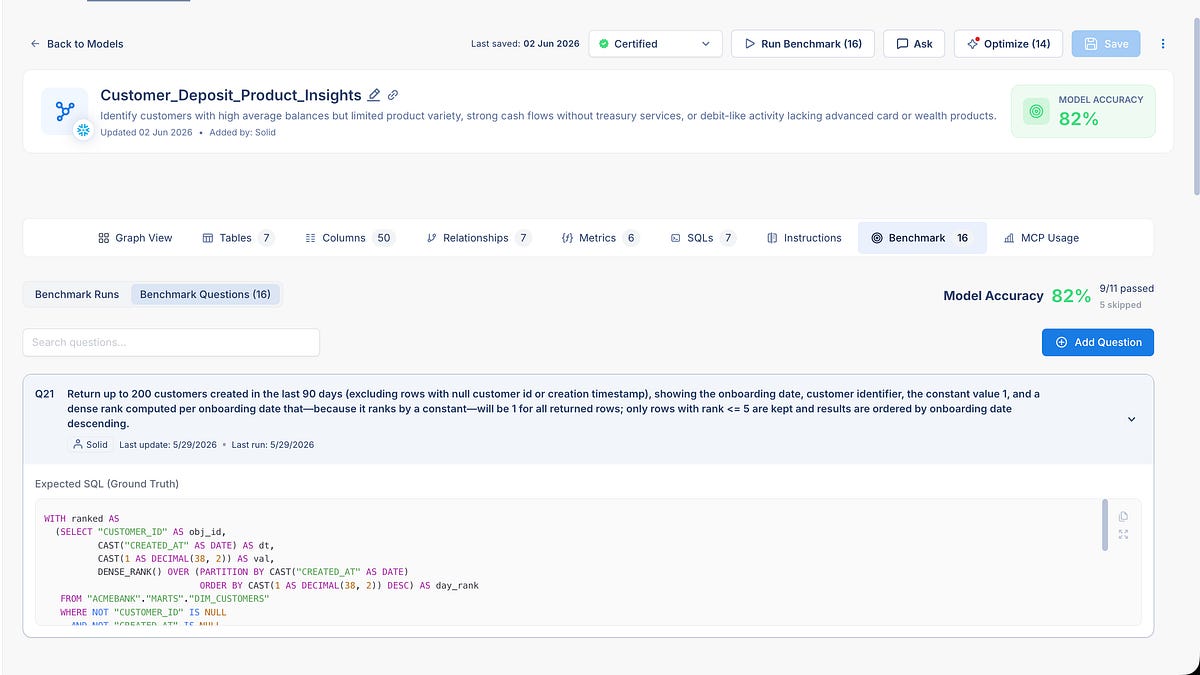
The scorecard specifically recommends testing against buyer-owned benchmarks, including held-out business questions and trusted SQL. That distinction matters because a model can produce syntactically valid SQL and still answer the wrong business question.
Evaluate both:
- Executable accuracy: Did the query run?
- Semantic accuracy: Did it actually answer the question correctly?
What to ask: How do you measure semantic accuracy, and can we test your system against our own questions and trusted answers?
4. Can the semantic model continuously prove that it still works?
Creating the model is only one step, and enterprise data changes constantly. Schemas and metrics change, business definitions change, new sources are added while old ones disappear.
A semantic model that was accurate six months ago may not be accurate today, so continuous testing should be a core requirement.
Look for capabilities such as:
- Automated benchmark testing
- Regression testing
- Impact analysis
- Join and relationship validation
- Metric validation
- Grain and calculation checks
- Confidence scoring
- Remediation workflows
What to ask: What happens when we change a metric or relationship? Can you show us what may break before that change reaches production?
5. Can the platform maintain itself as the business changes?
A semantic model that requires constant manual rebuilding can quickly become another time-intensive maintenance burden for your data team.
The scorecard specifically evaluates whether platforms can detect changes in:
- Schemas
- Data assets
- Usage patterns
- Business logic
- Downstream behavior
…and then subsequently help teams respond.
Look for automated maintenance, drift detection, ownership workflows, and operational telemetry. The goal here isn't to eliminate humans, but to make humans responsible for decisions and governance rather than endless manual maintenance.
What to ask: Show us what happens when our underlying data changes. How much work does your platform create for our team?
6. Is the entire model lifecycle governed and reversible?
Semantic logic is business logic. Changing a metric or relationship shouldn't be treated like editing a spreadsheet cell; there should be a clear lifecycle:
Draft → Test → Review → Approve → Publish → Monitor → Roll back if necessary
The scorecard calls specifically for versioning, impact analysis, approval, publishing, history, and rollback. (Note for Blair - this could be where we include an image of the scorecard?) This is even more important when the model is powering AI, as a change to even one definition could affect dashboards, AI answers, agents, and automated workflows simultaneously.
What to ask: Can we see exactly what changed, what it impacts, who approved it, and roll it back if something goes wrong?
7. Does governance extend beyond the semantic model itself?
Governance shouldn't stop at the definition of a metric. A modern platform should connect:
Business terms → Metrics → Assets → Owners → Lineage → Downstream consumption
It should also provide appropriate access controls, auditability, deployment controls, and consistent policies across downstream tools so that the semantic layer increasingly becomes a shared source of truth for both humans and machines.
If your approved definition of "revenue" is different depending on which AI tool someone uses, you don't actually have a governed semantic layer. You actually have multiple interpretations.
What to ask: Can approved definitions, permissions, and policies remain consistent wherever the model is used?
8. Can the model actually power AI and agents?
This is where semantic models become particularly important in an AI-first organization. It's not enough for a platform to have an AI-powered chat interface.
The more important question is: Can your trusted business context become real, trusted infrastructure for AI?
Look for the ability to activate the same governed model across:
- AI assistants
- AI agents
- BI tools
- Notebooks
- Custom applications
- Native warehouse AI
- Other analytics interfaces
And evaluate API and agent-protocol support if you expect to build custom workflows.
What to ask: Can the same approved semantic model power multiple AI and analytics experiences?
9. Can it control what AI is allowed to use?
Giving AI access to enterprise data isn't the same thing as giving AI access to trusted enterprise context. An AI system should be able to distinguish between an approved metric and an ambiguous or ungoverned data source.
The Solid scorecard specifically evaluates grounding and approved-context enforcement.
That means testing results when AI encounters:
- Ambiguous questions
- Conflicting definitions
- Unsupported requests
- Untrusted assets
- Missing context
A trustworthy system shouldn't just stop at producing an answer. It could be that the correct behavior for a situation is to ask for clarification, refuse to answer, or identify the uncertainty.
What to ask: Can AI be constrained to trusted assets and verified business definitions? Can we see what happens when it can't confidently answer?
10. What does this actually cost to operate at scale?
Finally, don't evaluate a semantic model platform based solely on its license price. Consider the total cost of ownership.
How much work does it take (in complete resource terms) to:
- Build models?
- Validate them?
- Maintain them?
- Fix drift?
- Govern changes?
- Support new domains?
- Add new data sources?
- Activate new AI experiences?
The scorecard also recommends evaluating implementation, support, operating model, scalability, performance, and commercial transparency.
A platform that appears inexpensive but requires significant ongoing manual effort may ultimately cost more than a platform that automates much of that work.
Ask vendors: What will this cost us, not just to buy, but to operate and maintain over three years?
Don't Stop at the Demo. Check the Decision Gates.
One of the most useful elements of the scorecard is its recommendation to establish mandatory decision gates before conducting a full vendor bake-off.
For example:
- Gate 1: Can it support your required warehouses in one governed deployment?
- Gate 2: Can it automatically generate a usable semantic model?
- Gate 3: Can you continuously test semantic accuracy against your own benchmarks?
- Gate 4: Does the model have a governed, reversible lifecycle?
- Gate 5: Can the same model activate multiple AI and BI endpoints?
- Gate 6: Does its security and data-handling architecture meet your mandatory requirements?
If a vendor can't clear a non-negotiable requirement, there's little value in spending weeks comparing secondary features.
Test the things that can disqualify a platform first.
The Bigger Shift: From Semantic Layer to Business Context
There's a larger idea underneath all of this assessment. Historically, semantic models were largely created to make BI more consistent, but enterprise analytics is no longer just about BI.
The same business context increasingly needs to power dashboards, analysts, AI applications, agents, automated insights, and other experiences we haven't even built yet. That means the semantic model itself needs to evolve.
Instead of being yet another layer buried inside a legacy analytics tool, it can become a shared, trusted representation of how the business works. That's the real opportunity and potential real value-add.
Your organization shouldn't need one definition of a metric for the warehouse, another for the BI platform, another for an AI assistant, and another for an agent. Aiming for one business understanding over many experiences reduces time spend and increases value, security, and cohesion.
The Semantic Model Platform Buyer Scorecard
Every vendor describes its platform a little differently, which makes demos hard to compare. We created the Semantic Model Platform Buyer Scorecard to help data and AI leaders ask consistent questions and compare what each vendor can demonstrate today.
The scorecard covers how each platform connects to your existing tools, builds semantic models, tests them over time, and manages changes. It also helps you assess governance, security, how the model supports AI and analytics, and what it costs to run at scale.
If you’re putting together an RFP, you can use the scorecard to turn those criteria into questions for each vendor.
Other posts